Enhancing COVID-19 Diagnosis: Leveraging GAN-Based Image Augmentation and Deep Learning for Improved Chest X-ray Classification
DOI:
https://doi.org/10.65718/inspireHealth.2026.2011Keywords:
COVID-19 Detection, Generative Adversarial Networks (GANs), Deep Learning, Data Augmentation, Chest X-rayAbstract
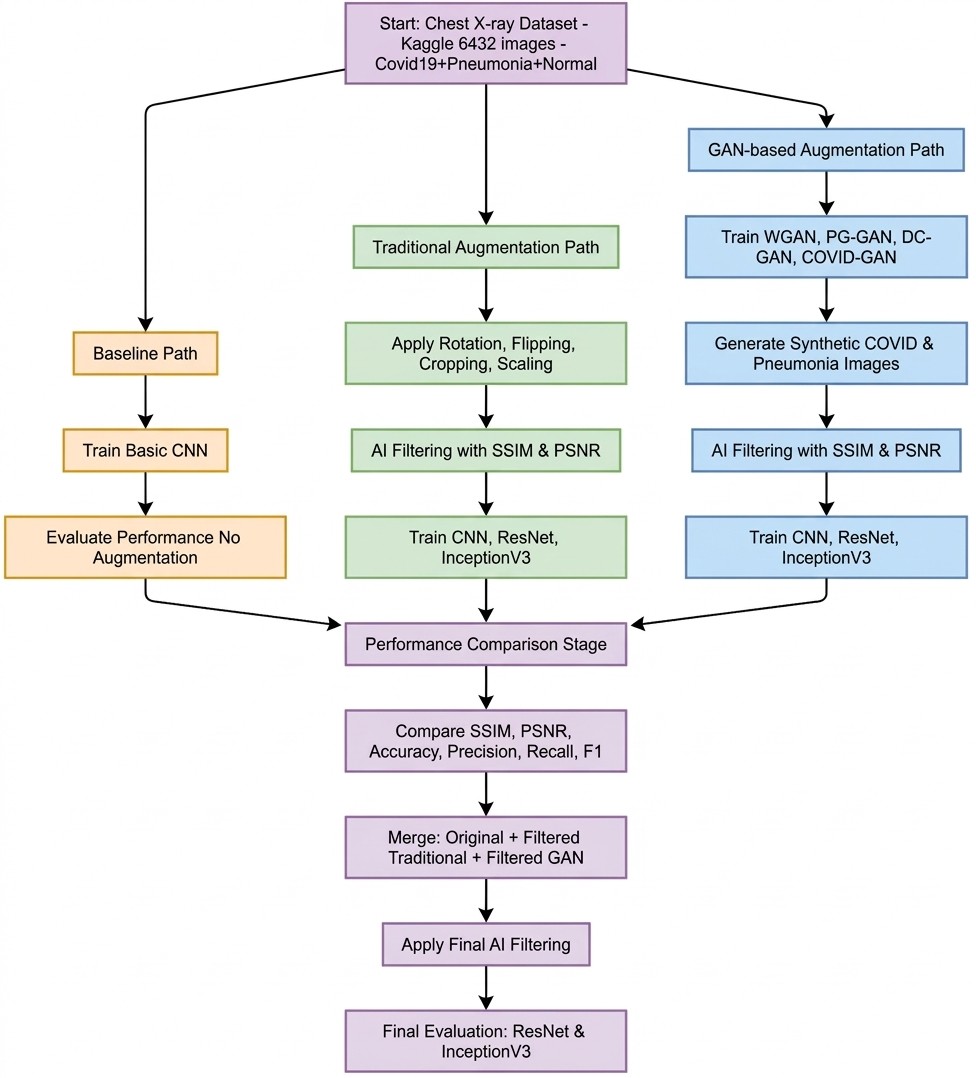
The SARS-CoV-2 virus caused COVID-19, which first appeared in late 2019 and quickly spread around the world, with more than 4 million confirmed cases and 286,000 deaths reported by May 2020. It was important to make quick and accurate diagnoses, but regular RT-PCR tests take a long time and a lot of resources. Deep learning models, especially Convolutional Neural Networks (CNNs), have shown promise in finding COVID-19 in chest X-rays. However, their effectiveness is compromised by the scarcity of annotated datasets; certain public datasets contain fewer than 2,000 COVID-positive images, resulting in overfitting and inadequate generalization. To fix this, we use Generative Adversarial Networks (GANs) to add fake images to the training data. However, visual and quantitative analysis (e.g., SSIM and PSNR) reveals that not all GAN outputs are of diagnostic quality. Training CNNs on unfiltered synthetic data can degrade performance. Therefore, this study introduces a filtering mechanism to retain only high-quality synthetic images for training, enhancing model reliability and accuracy. This approach demonstrates the potential of filtered GAN augmentation to overcome data scarcity and improve deep learning models for medical diagnosis.
Downloads
Published
Issue
Section
Categories
License
Copyright (c) 2026 Inspire Health Journal

This work is licensed under a Creative Commons Attribution-NonCommercial-NoDerivatives 4.0 International License.