Bayesian Hierarchical Mixture Cure Modeling for Survival Analysis in Oncology Trials
DOI:
https://doi.org/10.65718/inspireHealth.2026.2008Keywords:
Oncology trials, Mixture cure model, Bayesian, Survival analysis, Oncology, Health economic evaluation, Long-term extrapolationAbstract
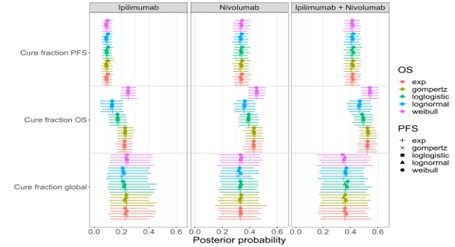
Survival analysis is an important part of clinical trials in oncology, especially when it comes to figuring out the long-term benefits of treatment and informing health technology assessment (HTA). This paper presents a Bayesian hierarchical framework for mixture cure models, addressing the complexities in estimating survival outcomes in oncology trials. Traditional survival models often fall short when an intervention is effective only for a subset of the population, leading to substantial right censoring and potentially misleading conclusions. By leveraging the correlation between multiple event types, such as overall survival (OS) and progression-free survival (PFS), the proposed model allows for the borrowing of information across event types, resulting in more accurate extrapolations beyond observed data. The model’s effectiveness is demonstrated using the Checkmate 067 trial data, showing improved stability in cure fraction estimates, even with limited follow-up. The approach offers significant advantages for health economic evaluations, particularly in estimating long-term survival and cost-effectiveness metrics like quality-adjusted life years (QALYs). The hierarchical model’s ability to incorporate prior knowledge and its robustness against small sample sizes underscore its value in clinical decision-making and policy formulation.
Downloads
Published
Issue
Section
Categories
License
Copyright (c) 2026 Inspire Health Journal

This work is licensed under a Creative Commons Attribution-NonCommercial-NoDerivatives 4.0 International License.