Artificial Intelligence to Super Intelligence: Semantics, Science, or Strategy?
DOI:
https://doi.org/10.65718/inspireAI.2026.1011Keywords:
artificial intelligence, superintelligence, AI terminology, AI semantics, AI policy, AI governance, AI safety, capability evaluation, public trust, super intelligence, defense AIAbstract
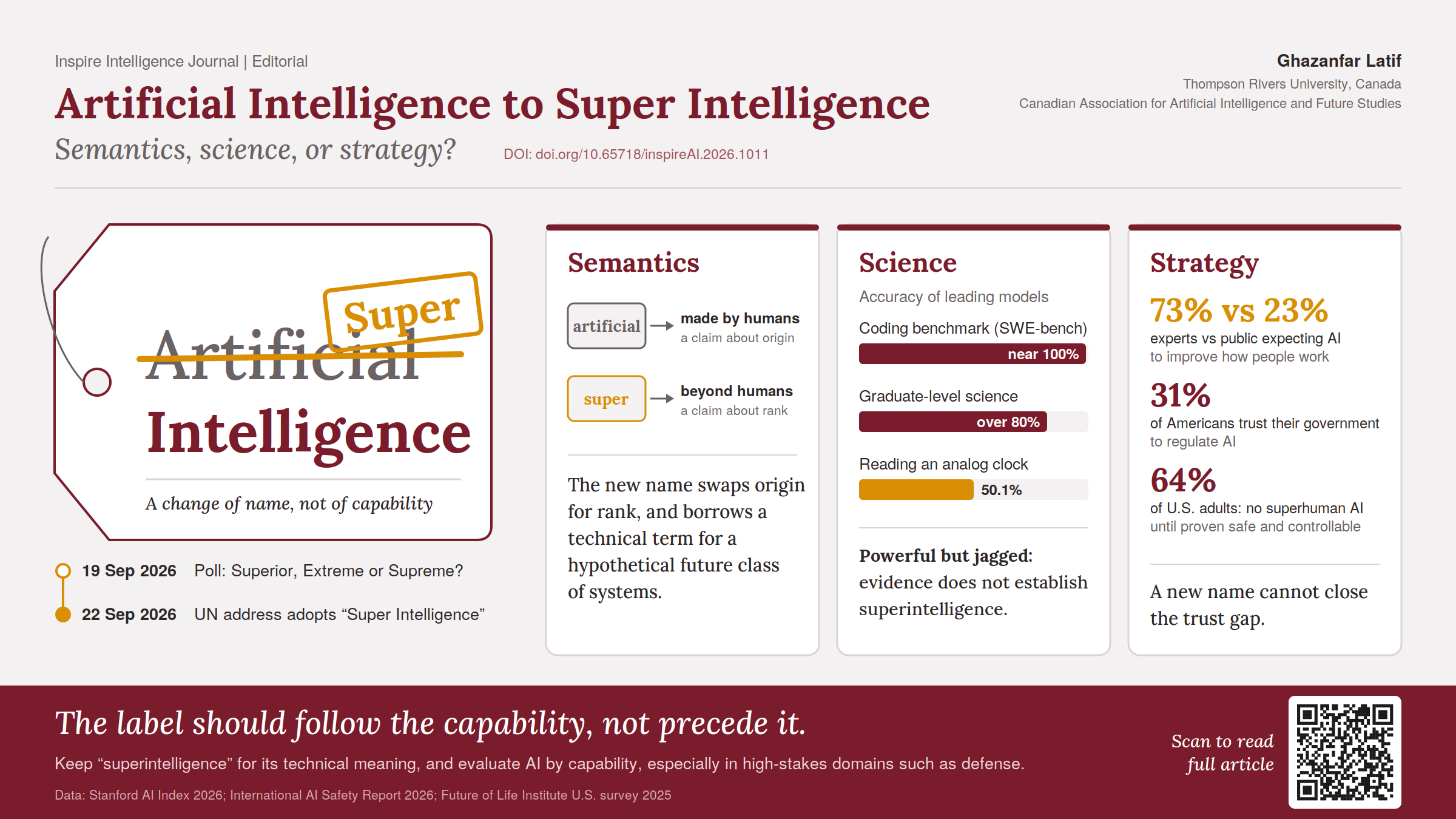
Over the past decade, artificial intelligence (AI) has advanced from narrow pattern-recognition systems to general-purpose models that write software, solve advanced mathematical problems, and support scientific discovery, and it is now transforming sectors from healthcare and education to finance, agriculture, and national security. Against this backdrop, on 22 September 2026, during his address to the 81st United Nations General Assembly in New York City, U.S. President Donald Trump announced that U.S. government documents would henceforth refer to artificial intelligence as Super Intelligence. This editorial examines the renaming through three lenses: semantics, science, and strategy. Drawing on the Stanford AI Index 2026, the International AI Safety Report 2026, and recent international public-opinion surveys, the analysis explores why the field adopted the word artificial and whether the new label is more accurate; it contrasts the proposed label with the established technical meaning of superintelligence and with current evidence on AI capabilities; and it considers the renaming in the context of United States-China competition, domestic public sentiment, and evolving policy priorities. It also considers the implications for defense, where capability-based evaluation matters most. Current AI capabilities remain impressive but uneven, and terminology surrounding AI has already become increasingly fluid across industry, media, and policy discourse. The analysis argues that the available public evidence is consistent with strategic considerations, while recognizing that political intent cannot be established from public statements alone. It also discusses how the terminology may affect scientific communication, education, and policymaking. The editorial concludes with recommendations for terminology, science communication, and editorial practice.
Downloads
Published
Issue
Section
Categories
License
Copyright (c) 2026 Ghazanfar Latif (Author)

This work is licensed under a Creative Commons Attribution-NonCommercial-NoDerivatives 4.0 International License.