Generative AI-Based Privacy-Preserving Next-Gen Student Support and Mental Health Navigation System
DOI:
https://doi.org/10.65718/inspireAI.2026.1007Keywords:
Generative AI, Student Support, Mental Health, LLMs, Data Privacy, RAG, Higher EducationAbstract
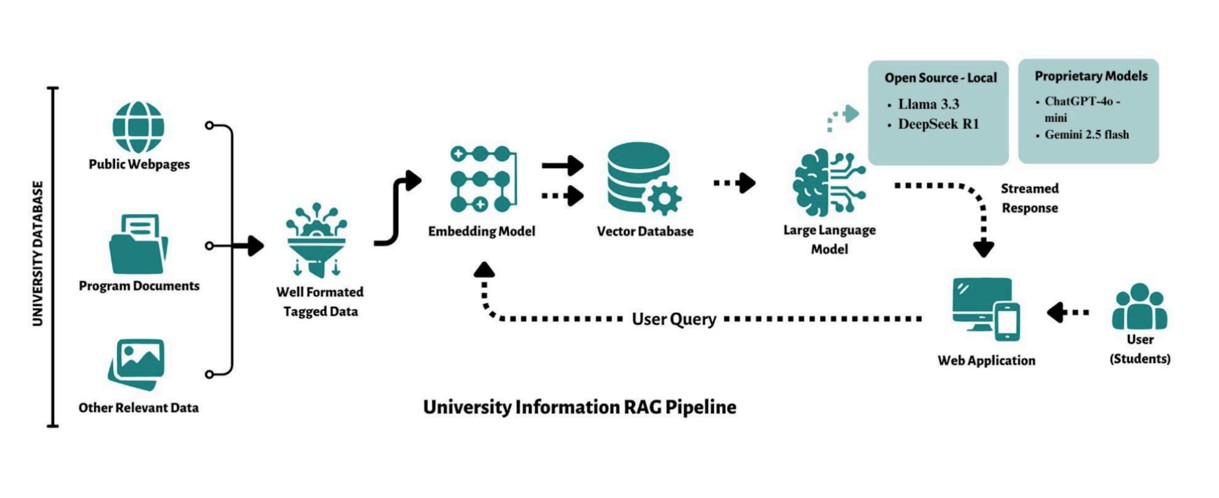
The increasing demand for accessible, 24/7 student support services in higher education presents a significant challenge, particularly in the domain of mental health. Generative AI and Large Language Models (LLMs) offer a scalable solution, yet their deployment is fraught with a critical dilemma between the performance and safety of proprietary models and the data privacy afforded by open-source alternatives. This paper presents a comparative study of four leading LLMs (open-source Llama 3 70B and DeepSeek R1; proprietary GPT-4o Mini and Gemini 2.5 Flash) for a university-specific student support chatbot at Thompson Rivers University. Using a custom knowledge base and a novel six-dimensional evaluation framework (Factual Accuracy, Contextual Relevance, Completeness, Tone & Empathy, Practical Utility, and Safety & Risk Management), we analyzed over 200 model responses to 50+ real-world student queries. The results reveal that while open-source models demonstrate parity in factual accuracy for academic questions, a critical performance gap exists in the human-centric attributes of safety, empathy, and utility, particularly in response to sensitive mental health queries. The study concludes that current open-source models, in their base form, are not yet suitable for unmonitored, student-facing deployment in high-stakes scenarios. We propose a hybrid deployment model as a pragmatic and responsible path forward for universities seeking to balance innovation with student welfare and data sovereignty.
Downloads
Published
Issue
Section
Categories
License
Copyright (c) 2026 Gursahib Singh, Jaspreet Kaur, Runna Alghazo (Author)

This work is licensed under a Creative Commons Attribution-NonCommercial-NoDerivatives 4.0 International License.